
We need you to help us with the 2025 Poppy Campaign. Can you be one of our Poppy Taggers?
If you're uncertain, Poppy “tagging” is the nickname for what Legion volunteers with trays of poppies are doing when you see them distributing poppies and collecting donations outside popular business locations in the period leading up to Remembrance Day on Nov. 11.
If you can offer your time, we have two ways to sign up to help us.
° In the branch
° Online
To sign up online, click on the link below and complete the form. Our Poppy Campaign team will contact you to finalize arrangements.
Thank you for volunteering
Fill out the form - https://forms.gle/be3zAnuYegQJWfaf8

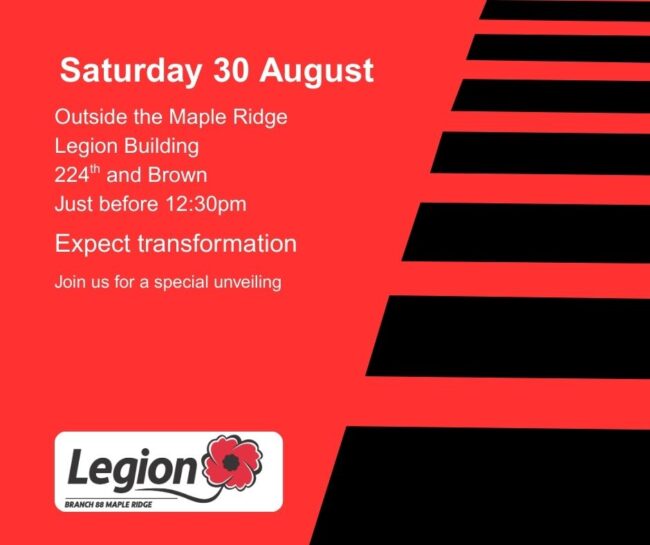
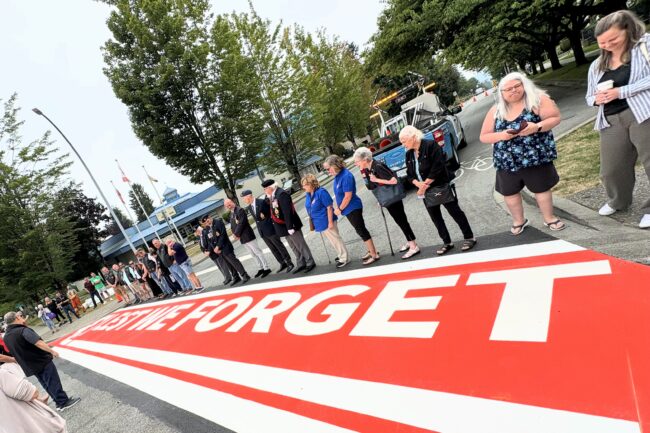
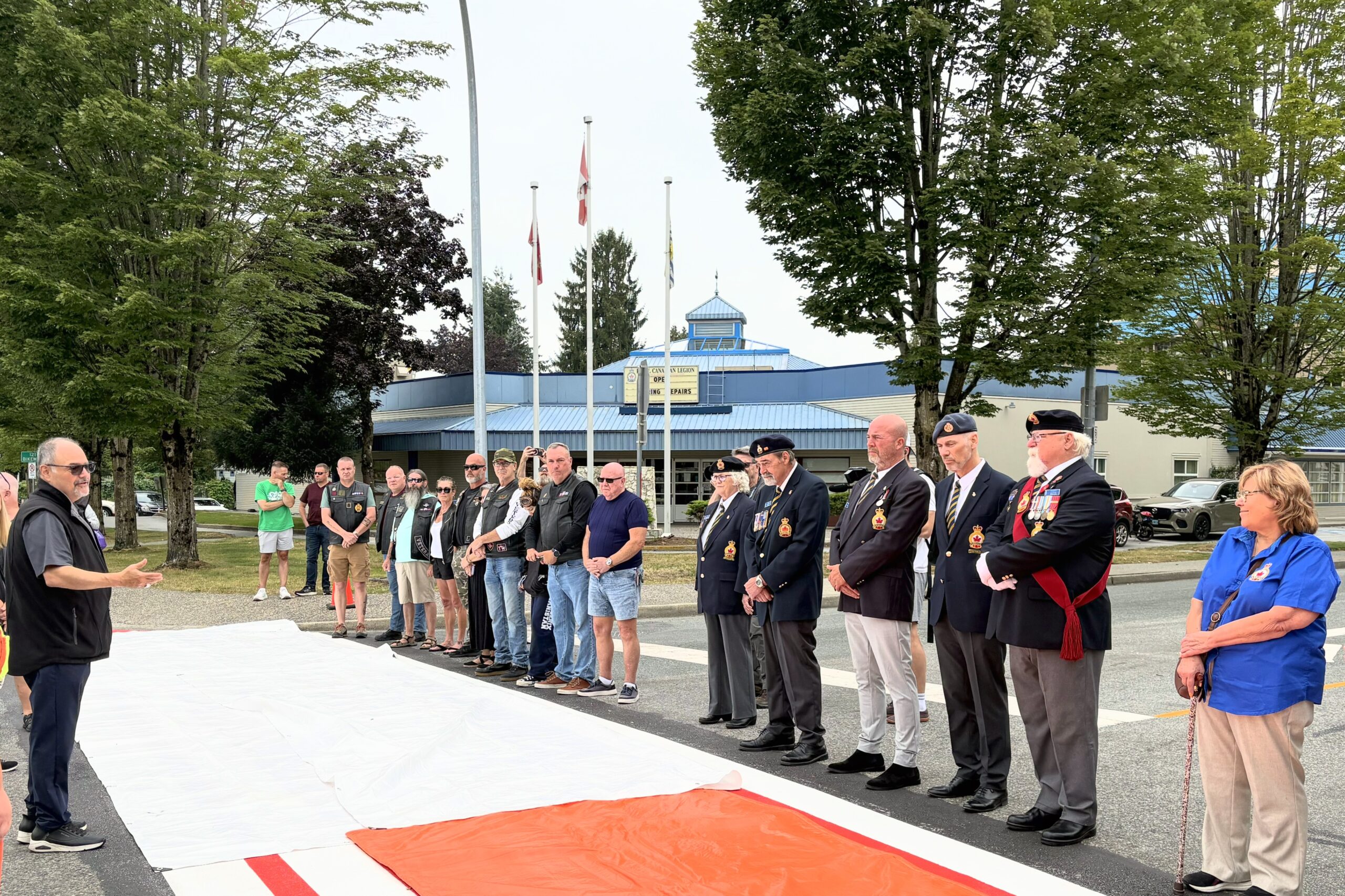
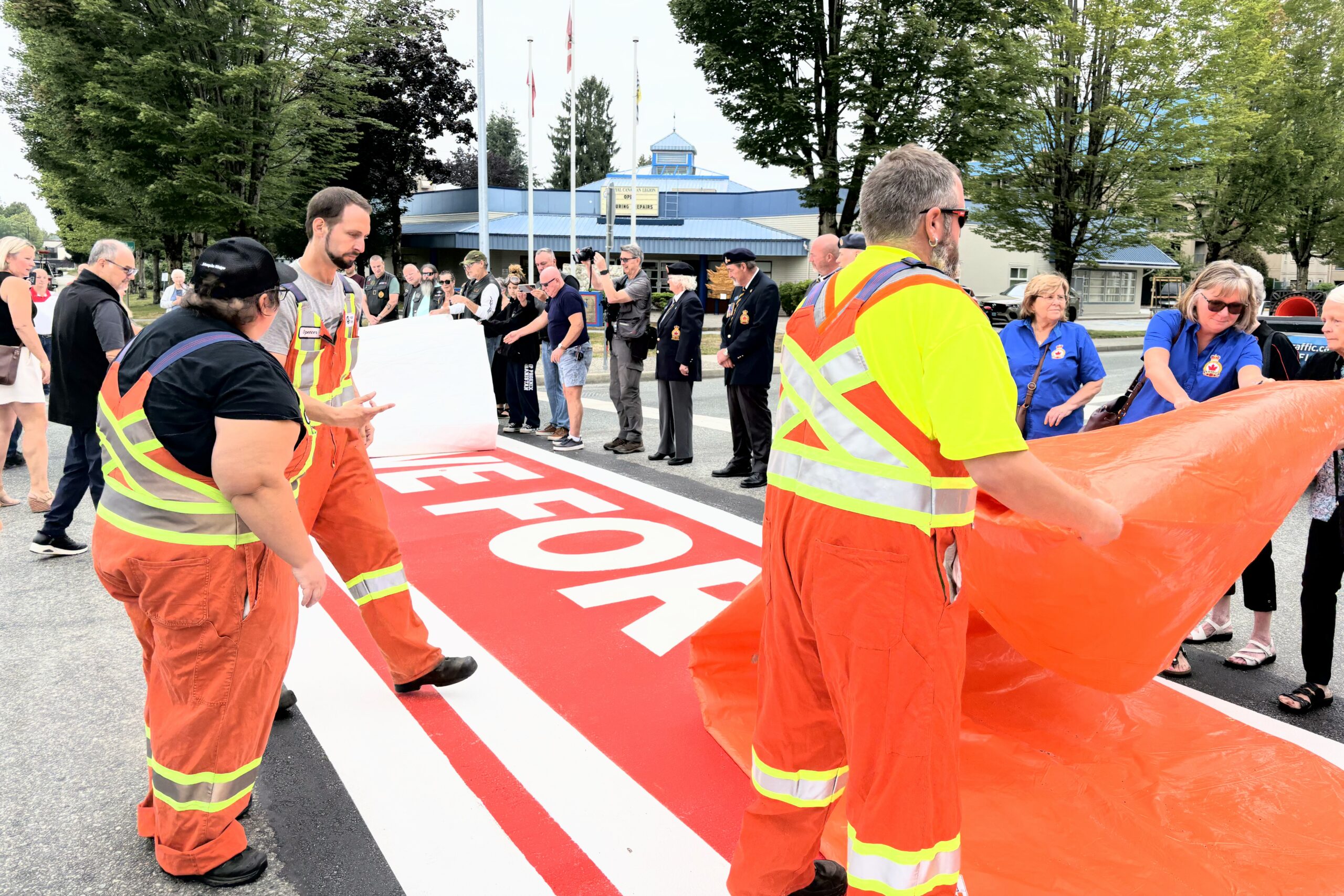
Saturday August 30th just before 12:30pm. Please join us!

Canadians took part in many hard struggles to help the Allies to victory during the Second World War. D-Day and the Battle of Normandy was one of the best-known chapters of the entire conflict and our service members would play an important role in this pivotal campaign.
Destroyers and supporting craft of the Royal Canadian Navy shelled German positions onshore and cleared sea mines in the approaches to the French beaches. Many Royal Canadian Air Force planes were among the some 4,000 Allied bombers and 3,700 fighters / fighter bombers that relentlessly struck at shoreline defences, inland targets and enemy squadrons that day.
More than 450 members of the 1st Canadian Parachute Battalion jumped inland before dawn on June 6 and were the first of our soldiers to engage the enemy on D-Day. A few hours later, some 14,000 Canadian troops from the 3rd Canadian Infantry Division and the 2nd Canadian Armoured Brigade—composed of military units from coast to coast—would begin to come ashore at Juno Beach. Their mission was to brave heavy fire to establish a foothold along an eight-kilometre stretch of coastline fronting the villages of Saint-Aubin-sur-Mer, Bernières-sur-Mer, Courseulles-sur-Mer, and Graye-sur-Mer. Our soldiers would then push inland towards the city of Caen, an important communications and transport centre.
Victory in the Battle of Normandy came at a terrible cost. The Canadians suffered the highest casualties of any divisions in the British Army Group during the campaign. Some 359 Canadian soldiers were killed on D-Day alone, and a total of more than 5,000 of our men would die during the two-and-a-half-months of fighting in Normandy. Most of these fallen heroes lie buried in France in the beautiful Bény-sur-Mer Canadian War Cemetery and the Bretteville-sur-Laize Canadian War Cemetery. Over 13,000 more of our soldiers were wounded in Normandy, with many suffering injuries to body and mind that they would carry for the rest of their lives.
Canada’s impressive efforts in the Second World War remain a point of great national pride, even many decades later. The brave Canadians who came ashore on D-Day and saw action in the Battle of Normandy were among the more than one million men and women from our country who served in the cause of peace and freedom during the conflict. Sadly, over 45,000 of them would lose their lives.
Read the full account at Veterans Canada
Image credits: Library and Archives Canada


8 May 1945 – VE Day (Victory in Europe Day) – was one that remained in the memory of all those who witnessed it. It meant an end to nearly six years of a war that had cost the lives of millions; had destroyed homes, families, and cities; and had brought huge suffering and privations to the populations of entire countries.
Millions of people rejoiced in the news that Germany had surrendered, relieved that the intense strain of total war was finally over. In towns and cities across the world, people marked the victory with street parties, dancing and singing.
But it was not the end of the conflict, nor was it an end to the impact the war had on people. The war against Japan did not end until August 1945, and the political, social and economic repercussions of the Second World War were felt long after Germany and Japan surrendered.
With Berlin surrounded, Adolf Hitler committed suicide on 30 April 1945. His named successor was Grand Admiral Karl Dönitz. During his brief spell as Germany’s president, Dönitz negotiated an end to the war with the Allies – whilst seeking to save as many Germans as possible from falling into Soviet hands.
A German delegation arrived at the headquarters of British Field Marshal Bernard Montgomery at Lüneburg Heath, east of Hamburg, on 4 May. There, Montgomery accepted the unconditional surrender of German forces in the Netherlands, northwest Germany and Denmark. On 7 May, at his headquarters in Reims, France, Supreme Allied Commander General Eisenhower accepted the unconditional surrender of all German forces. The document of surrender was signed on behalf of Germany by General Alfred Jodl and came into effect the following day.
Soviet leader Josef Stalin wanted his own ceremony. At Berlin on 8 May, therefore, a further document was signed – this time by German Field Marshal William Keitel. Dönitz’s plan was partially successful and millions of German soldiers surrendered to Allied forces, thereby escaping Soviet capture.
The news of Germany’s surrender was not surprising. It had been anticipated for some time and people across Britain were on standby to start celebrating the end of the war.
The announcement that the war had ended in Europe was broadcast to the British people over the radio late in the day on 7 May. The BBC interrupted its scheduled programming with a news flash announcing that Victory in Europe Day would be a national holiday, to take place the following day. Newspapers ran the headlines as soon as they could, and special editions were printed to carry the long-awaited announcement. The news that the war was over in Europe soon spread like wildfire across the world.
The news that the war was over in Europe quickly spread around the world, and people of the British Empire and the Allied countries wanted to celebrate the defeat of Nazi Germany.
In the United States of America, the victory was tempered with the recent death of President Roosevelt, who had led his country through the war years. His successor, Harry S. Truman, dedicated the day to Roosevelt and ordered that flags be kept at half-mast – as part of the 30-day mourning period. Despite this, there were still scenes of great rejoicing in America: in New York, 15,000 police were mobilised to control the huge crowds that had massed in Times Square.
In Australia, the celebrations were also tinged with a sombre mood. The war in the Far East and Pacific was still being fought, and many Australians were serving overseas. But there were scenes of rejoicing in many cities, and services were held in churches around the country to give thanks for the war ending in Europe.
In Paris, huge numbers of people flocked to the centre of the city to celebrate. An eyewitness recalled: ‘On the Champs Elysees they were singing 'It's a Long Way to Tipperary,'…in the Place de la Concorde to the Arc de Triomphe in the Place de l'Etoile, there was hardly any place to breathe and no place at all to move.’
The charged atmosphere and large crowds could lead to unrest. In Halifax, Canada, riots broke out among the large concentration of military personnel stationed there. Thousands of soldiers, sailors and civilians looted liquor stores – which had been closed for the VE Day holiday – and the resulting riots and vandalism resulted in several deaths.
Source: Imperial War Museum

One of history's most famous wartime poems, "In Flanders Fields" was written during the First World War by Canadian officer and surgeon John McCrae. It helped popularize the red poppy as a symbol of Remembrance.
 Ypres
YpresWhen he volunteered at age 41 for service in the First World War, McCrae wrote to a friend that "I am really rather afraid, but more afraid to stay at home with my conscience." In April 1915, McCrae and a young friend, Alexis Helmer, joined the 18,000 soldiers of the First Canadian Division in their positions near Ypres, Belgium. The Second Battle of Ypres commenced on 22 April and lasted for six hellish weeks. It was during this battle that the Germans launched the first large-scale poison gas attacks of the war.
A Montréal physician, McCrae served as a major and a surgeon with the Canadian Field Artillery, in the Canadian Expeditionary Force. Ypres was the Force's first major engagement of the war.
"The general impression in my mind is of a nightmare," McCrae wrote to his mother, "... And behind it all was the constant background of the sights of the dead, the wounded, the maimed, and a terrible anxiety lest the line should give way."
On 2 May, Alexis Helmer was killed. Because the brigade chaplain was absent, McCrae — as the brigade doctor — conducted the burial service for his friend. Later, at Helmer's grave, he wrote a few lines of verse that were the beginning of the poem "In Flanders Fields."
Before the war, McCrae had written poetry in Canada, and some of his work had been published there.
McCrae later sent a finished copy of "In Flanders Fields" to The Spectator magazine in London, where it was rejected. But a journalist who visited the field hospital where McCrae was serving at the front, took a copy back to Punch magazine. Punch printed it — anonymously, without McCrae's name — on 8 December 1915.
Within months it was republished in other sources, with McCrae's name attached, and quickly became the most popular poem of the war. Its powerful use of the symbol of the poppies blooming from the churned earth led to the tradition, to this day, of the poppy as a symbol of remembrance for those killed in service.
By 1917, "In Flanders Fields" was known throughout the English-speaking world. It was used to further the war effort, to raise money for the troops, and to help recruit American soldiers as the United States mobilized to enter the war. John McCrae soon became a household name in the US.
Today, McCrae's poem is read by millions in Canada and around the world each Remembrance Day. There have also been various settings to music, among which that of William Hewlett is used during Remembrance Day ceremonies in Ottawa. (See In Flanders Fields Music.) A history museum in the ancient Cloth Hall in Ypres (now Ieper), Belgium, is named after the poem. The special exhibition gallery in the Canadian War Museum is also named for McCrae.
"In Flanders Fields"
In Flanders fields the poppies blow
Between the crosses, row on row,
That mark our place: and in the sky
The larks still bravely singing fly
Scarce heard amid the guns below.
We are the dead: Short days ago,
We lived, felt dawn, saw sunset glow,
Loved and were loved: and now we lie
In Flanders fields!
Take up our quarrel with the foe
To you, from failing hands, we throw
The torch: be yours to hold it high
If ye break faith with us who die,
We shall not sleep, though poppies grow
In Flanders fields"
Composed at the battlefront on 3 May 1915 during the Second Battle of Ypres, Belgium.
Source: The Canadian Encyclopedia

Anzac Day is a national day of remembrance in Australia, New Zealand and Tonga that broadly commemorates all Australians and New Zealanders "who served and died in all wars, conflicts, and peacekeeping operations" and "the contribution and suffering of all those who have served". Observed on 25 April each year, Anzac Day was originally devised to honour the members of the Australian and New Zealand Army Corps (ANZAC) who served in the Gallipoli campaign, their first engagement in the First World War (1914–1918).
Anzac Day marks the anniversary of the first campaign that led to major casualties for Australian and New Zealand forces during the First World War. The acronym ANZAC stands for Australian and New Zealand Army Corps, whose soldiers were known as Anzacs. Anzac Day remains one of the most important national occasions of both Australia and New Zealand.
In 1915, Australian and New Zealand soldiers formed part of an Allied expedition that set out to capture the Gallipoli Peninsula in the Ottoman Empire to open the way to the Black Sea for the Allied navies. The objective was to capture Constantinople, the capital of the Ottoman Empire, which was a member of the Central Powers during the war. The ANZAC force landed at Gallipoli on 25 April, meeting fierce resistance from the Ottoman Army commanded by Mustafa Kemal (later known as Atatürk). What had been planned as a bold strike to knock the Ottomans out of the war quickly became a stalemate, and the campaign dragged on for eight months. At the end of 1915, the Allied forces were evacuated after both sides had suffered heavy casualties and endured great hardships. The Allied deaths totalled over 56,000, including 8,709 from Australia and 2,721 from New Zealand. News of the landing at Gallipoli made a profound impact on Australians and New Zealanders at home and 25 April quickly became the day on which they remembered the sacrifice of those who had died in the war.
Though the Gallipoli campaign failed to achieve its military objectives of capturing Constantinople and knocking the Ottoman Empire out of the war, the actions of the Australian and New Zealand troops during the campaign bequeathed an intangible but powerful legacy. The creation of what became known as an Anzac legend became an important part of the national identity in both countries. This has shaped the way their citizens have viewed both their past and their understanding of the present. The heroism of the soldiers in the failed Gallipoli campaign made their sacrifices iconic in New Zealand memory, and is often credited with securing the psychological independence of the nation.
Read more on the Wiki ANZAC entry
Visit the Australian War Memorial for more information on ANZAC Day